IN RUE WE TRUST(ED)
Updated: Aug 9
After seven years, three seasons, and 26 episodes, Euphoria is officially over. And fittingly, the final episode, “In God We Trust,” turns the show’s long obsession with faith, addiction, punishment, and mercy into one last provocation.
The series began as a moody, glitter-smeared teen drama about high school students navigating drugs, sex, identity, trauma, social media, love, and friendship. But what started as a heavy exploration of Gen Z angst ended in a wild, wild west of debt, danger, and nihilism.
At the center of it all was Rue Bennett, Zendaya’s funny, wounded, self-aware narrator and the show’s most devastating contradiction. Rue was our guide through writer/director Sam Levinson’s somewhat overheated vision of suburban high school life. Her haplessness endeared her to us, while her nonchalant reactions to her friends’ behavior cooled down what was essentially adolescent fever dream. With her fuzzy but consistent moral clarity, she narrated her life like someone trying to beat everyone else to the punch: born three days after 9/11, diagnosed with OCD, ADHD, anxiety disorder, and bipolar disorder, then gutted by her father’s death until grief swallowed her — and she swallowed her first pill.
But Rue’s story isn’t addiction to redemption. It’s the story of the collapse of every fantasy Euphoria first let us believe about her.

I mean, I'm all good with drugs until guns start coming out.
While Euphoria is something of an ensemble piece, its main current has always been Rue’s post-rehab return. At 17, Rue Bennett is back at high school with a dark cloud over her head. She's still using, still lying, and still letting her mother believe recovery is going a lot better than it is.
Around her, the show builds a distinctive subsection of peers: Nate Jacobs (Jacob Elordi), Maddy Perez (Alexa Demie), Cassie Howard (Sydney Sweeney), Lexi Howard (Maude Apatow), and, most notably, Jules Vaughn (played by a mesmerizing Hunter Schafer), the new girl whose arrival gives Rue something that feels dangerously close to hope.
The heartbeat of Euphoria Season 1 was Rue and Jules' relationship. Jules arrived like a flare in the dark, and viewers followed both characters working through trauma while kindling a romance, as Jules became the fragile center of Rue’s sobriety.

Jules is carrying her own demons, including the trauma of being committed to a psych ward by her mother for being trans. With Nate Jacobs's threats looming over her, she begins to yearn for her old life in the city.
That's why the train station finale hit so hard. After hatching a half-baked plan to run away, Rue and Jules end up on a deserted platform with two very different needs. Jules, exhausted by a brutal year as the new girl and desperate for escape, gets on the train. Rue can't bring herself to leave. So she stands there, shattered, watching the girl she loves roll away without her.
The season ends with a rhapsodic portrayal of her relapse, turning heartbreak into something operatic without letting us forget what it is: a return to the thing that's been waiting for her all along.
The bridge episode with Rue in a diner with Ali (played by Colman Domingo), her sponsor and eventual mentor, saying the she doesn't plan on being alive for long remains one of the show’s best scenes. It understands something crucial: Rue’s self-awareness is not the same as accountability. She can describe the damage with startling clarity, but recognition is passive. Accountability requires movement, and Rue isn't ready to move.
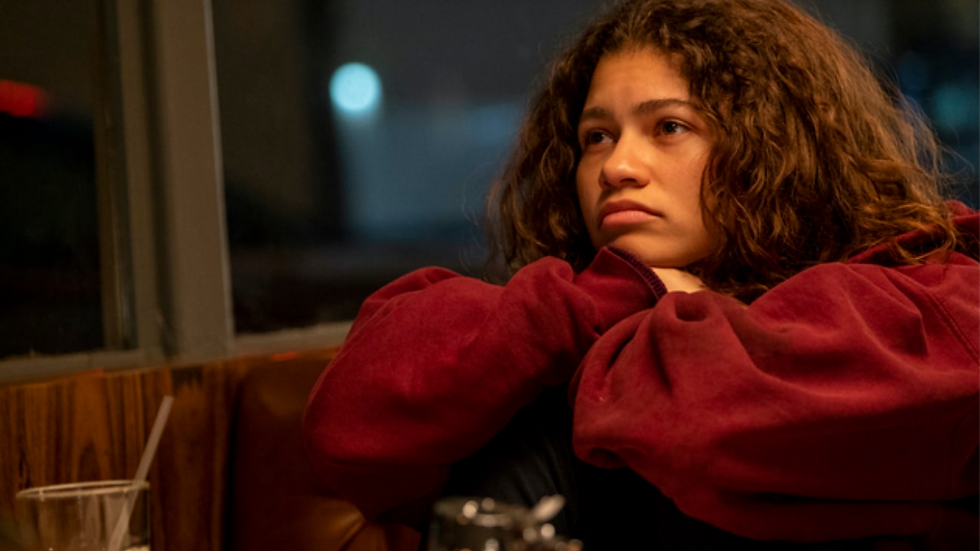
In Season 2, Rue's relapsed, but the season’s real tension comes from how carefully she tries to package the lie. She lies to her mother Leslie (Nika King), her younger sister Gia (Storm Reid). She uses with a new friend Elliot (Dominic Fike), who quickly becomes both confidant and enabler. And she makes her most dangerous decision when she crosses paths with Laurie, a soft-spoken drug dealer who gives Rue a suitcase full of pills to sell.
Rue, naturally, has no real plan to sell them. Instead, she uses from the stash, hides it from her family, and treats the suitcase like a secret door out of withdrawal, debt, and reality. It's a terrible plan, made worse by the fact that Rue mistakes secrecy for control. She's not just falling apart. She's building a trap and calling it an exit.
Of course, the lie can't hold. And one morning, when Jules and Elliot tell Leslie the truth, Rue’s carefully managed double life collapses. “Stand Still Like the Hummingbird” is the episode where every fantasy of Rue breaks at once. Leslie’s fear can't stop her. Gia’s pain can't reach her. Jules and Elliot’s confession can't shake her. To Rue, every attempt to help her is an attack.

By the end of Season 2, Rue walking away from Jules feels like the first honest thing she's ever done. It's not a clean new beginning. It's recognition. Jules has become another place for Rue to hide, and whatever care remains between them can't keep functioning as a survival plan.
And Rue's in survival mode.
For Season 3, there's the time jump. Rue's older, which, in Euphoria, doesn't mean freer. She's spent the past five years ferrying fentanyl across the Mexican border, working off her debt to Laurie (Martha Kelly). That is until she's rescued, so to speak, by Alamo Brown (Adewale Akinnuoye-Agbaje). Alamo isn't the kind of man who needs to raise his voice to announce himself. A strip-club mogul and drug boss with a cowboy’s sense of theater, he gave Rue work handling strippers, pulled her deeper into his orbit, and eventually promoted her to arms dealer.
At the same time, Season 3 keeps circling faith like it wants to believe in something and doesn't quite trust itself to. Ali is still pushing Rue toward accountability without confusing forgiveness for permission. But Euphoria doesn't let faith function like a magic door.

By the finale, Alamo believes Rue has betrayed him after discovering she's working for the DEA, and his punishment is terrifying because of how small it looks.
Rue, recovering from a long day of double-crossing her boss and suffering a wound on her palm, overdoses on Percocet secretly laced with fentanyl. The sequence stands out for its contemplative beauty. Rue dreams of walking through her childhood home and seeing her mother, reaching for her before being embraced in return. Reality and fantasy blur. And Rue ultimately dies at Ali’s house, a place that should have meant safety.
Euphoria’s troubled protagonist spent so much of the drama’s final season dodging one potentially violent death after another. Yet when she does die, midway through the series finale episode, she goes gently.
In the end, Rue isn't undone by one missing piece, or one bad choice. She's undone by the same thing the show has been tracking from the beginning: the gap between wanting relief and being able to survive the cost of it.

every time I feel good, I think it'll last forever, but it doesn't.
I’ve known addicts. I’ve known alcoholics. I’ve known people who promised they’d stop or quit, and did for a while. But they always—at least in my personal life—returned to who they’d always been. It makes me think of that saying: when people tell you who they are, believe them. (Or maybe Jack Sparrow's "You can always trust a dishonest person to be dishonest") And through three seasons spanning years, I kept asking myself: who was Rue Bennett, really?
Rue dying always seemed like where things would end up, albeit in this case, she was flat-out murdered by Alamo who knew she wouldn't resist relief. It did seem like the show was trying to make a point that she wasn’t actually abusing drugs, just taking it because the cut on her hand hurt, rather than just taking it to get high.
But that's part of what makes the ending so frustrating. In isolation, Rue’s final dream sequence is beautiful: her imagined mission to save Fez, Rue’s dealer and one of her closest friends turned inmate, the tearful goodbye to her mother, the soft blur of a mind trying to make meaning in its final moments. But beauty isn't the same as clarity. And while watching the strange sequence, you keep wondering where the show could possibly be going, until it becomes clear that none of it is happening at all. It's Rue’s dying mind giving herself the closure the world no longer can.

Yet I can't help but feel shorted. The only truth of who rue really was to those around her comes from Ali, who's been upgraded from side character to protagonist to Rue's stand in father figure. Ali's put a lot of time and care into tending to addicts and his efforts have, for him, felt fruitless—well, until he blows Alamo's spleen out.
But that's the brutal thing about addiction. Suffering is communal.
Everyone who loved Rue has been forced to build a life around the possibility of either losing her or cutting her out. Leslie can never fully relax into being her mother because she's always bracing for the next relapse. Gia grows up with Rue’s addiction as the background noise to her entire childhood. Jules gets pulled into a love that starts to feel less like intimacy and more like responsibility. And the show’s larger ideas about love, goodness, and faith become most alive when they're pressed against Rue’s addiction. Love, after all, is part of what drives Rue to use in the first place.
And Rue can find faith, seek forgiveness, and try to imagine herself as someone other than the worst things she's done, but the consequences of her addiction, in the end, were still waiting for her.
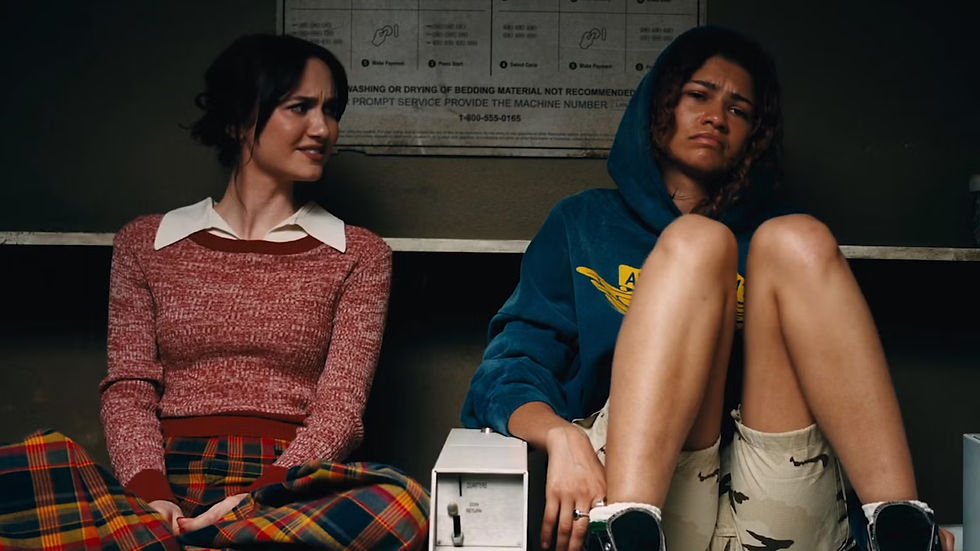
It's a bleak, over-simple conclusion for a show that's spent years making almost everything feel so, so complicated. Look, I'm not here to defend Alamo Brown, nor to argue in favor of always turning the other cheek. The bad man had to go, and I’m glad the bad man is gone. But Euphoria tries to have it both ways: the empty but “honest” portrayal of Rue’s most likely fate on one hand, and the far-fetched revenge fantasy for her death on the other.
After everything the show's put us through, we're left with Cassie alone in her modern-day brothel —a dollhouse filled with shiny things and zero substance, Lexi once again taking the moral high ground without fully grasping why, and Ali... on a farm.
Rue’s fate underlines how addiction can be a frustratingly misunderstood disease, but the show around her keeps undercutting that message with such over-the-top storytelling. In its conclusion, Euphoria tries to be both a serious look at the fentanyl epidemic and an extended homage to action-Western tropes about good and evil.

I know it all may seem sad, but guess what? I didn't build this system, nor did I fuck it up.
After Rue's death, the show’s perspective shifts to Ali (now Martin) as we come to know him more fully. It uses him to give shape to the grief Rue left behind. (If you’re going to hand the final moral argument of your series to someone, you better give it Colman Domingo.) At his last Narcotics Anonymous meeting, Ali admits he once believed empathy could change how people understood addiction. Now, he's no longer sure empathy is enough. There's a difference, he argues, between struggling and poisoning kids for money. Some things aren't complicated. Some things are just evil.
The finale title “In God We Trust” lands like a dare because, by the end, trust became the show’s most unstable idea. Trust in God. Trust in recovery. Trust in love. Trust that a story this painful will bend toward mercy because we've watched this girl suffer long enough. Trust in Rue.
But Euphoria was never that generous.


Comments