CAN LOVE EVER TRULY BE UNCONDITIONAL? A24'S “THE DRAMA” SEEMS TO THINK SO.
Updated: Aug 9
Since its release on Friday, The Drama has split audiences clean in two. Some have praised it as wildly entertaining; others have found it deeply unsettling—a reaction that speaks not just to the film, but to the very real and ongoing trauma surrounding the subject it engages.
The story tracks the life and love of Emma and Charlie (Zendaya and Robert Pattinson being charming as hell), going back to their first meeting, though it largely focuses on the run-up to their wedding. Almost parodically ideal, the two are hot, young, successful professionals with interesting-seeming jobs and enough money for the kind of aspirational, art-and-book-filled apartment that suggests bohemia without the struggle. From the outside, their life looks as frictionless as any in a Nancy Meyers movie. But, of course, it’s complicated.

MAJOR SPOILERS FOR "THE DRAMA" FROM THIS POINT
What's the worst thing you've ever done?
The Drama starts as a romantic comedy.
We first meet Charlie and Emma in golden sunlight at a café. She’s reading a novel; he’s scheming how to approach her. (He checks her Goodreads page and fakes it, naturally.) When he finally gets up the nerve to speak, she can’t hear him—music in one ear, deaf in the other. He fumbles; Some confusion and awkwardness ensues until Emma clocks what’s happening and lets Charlie off the hook with a forgiving smile and an interested query: “Can we start over?” It’s a movie-worthy meet-cute, a fact Charlie himself notes as he works on his wedding speech, and a framework that allows the film to drift through a series of golden-hued flashbacks: first date, first kiss, first night spent together.
The couple are the picture of young love—successful, beautiful, having great sex, living in an enviable apartment with a spiral staircase. But all of this evaporates, queasily and in what feels like slow motion, over wine with their two best friends/wedding party, Mike (played by Archive 81's Mamoudou Athie) and Rachel (played by a razor sharp Alana Haim). The latter suggests a game: What’s the worst thing you’ve ever done?
Mike’s is a failure of chivalry. Rachel’s is a piece of childhood cruelty. Charlie cops to some light cyberbullying in grade school. And then Emma—tipsy, loose, unguarded—reveals that as a depressed, isolated teenager in Louisiana, she once planned a mass shooting, even doing target practice with her father’s rifle. (She’s deaf in one ear because she accidentally blew out her eardrum while practicing in the woods.) But, she didn’t go through with it. She was just in a bad place, she explains.

The confession lands exactly how you’d expect—maybe worse. Mike is horrified. Rachel, whose cousin was paralyzed in a random act of gun violence, is righteously outraged. Charlie scrambles to wake up from what he hopes is a bad dream. Emma vomits, then tries to take back what can’t be unsaid.
And just like that, love has a condition.
There's...some drama.
What The Drama understands—and what the discourse around it has largely avoided—is that this isn’t really a film about shock. (Though it is shocking.) It’s about exposure. Not just of Emma’s past, but of the unspoken limits that underpin every relationship.
Because “unconditional love” is one of those ideas that sounds beautiful until you try to define it.
We say it easily. We believe it, even. That love—real love—should be boundless, forgiving, expansive enough to hold the worst parts of someone without breaking. But in practice, most love is conditional. It’s built on a set of assumptions: who this person is, what they’re capable of, what they’ve done—and crucially, what they haven’t.
Emma’s confession (despite its tone deaf nature) collapses the version of her that Charlie thought he knew. And in its place is something harder to categorize. And harder to love without qualification.

Pattinson delivers some of the best work of his career as Charlie sputters, rationalizes, fantasizes, and downplays, functioning as both character and proxy for the audience in Director Kristoffer Borgli’s unsavory thought exercise. What if the love of your life admitted to violent thoughts? Could you ever really trust them? And how much do you actually want to know?
The film finds bleak comedy in that spiral—the disastrously timed engagement photoshoot, Charlie’s increasingly desperate attempts to normalize the unthinkable—but it never lets the question loosen its grip. Because beneath the absurdity is something uncomfortably recognizable: the way we negotiate love in real time, adjusting our boundaries in response to new information, deciding—sometimes in an instant—what we can live with.
What makes The Drama particularly thorny is that Emma didn’t do the thing. The violence exists in intention, not action. Which raises a more complicated question: is love contingent on what someone has done, or what they're capable of doing?
Charlie can’t land there, not immediately, maybe not at all. Instead, he hovers in a far messier space, one where love and repulsion coexist, where memory competes with revelation.

Rachel, however, represents the cleanest answer: For her, Emma is unredeemable. Full stop. But the film is less interested in moral clarity than it is in moral friction.
And crucially, one where knowing becomes its own kind of burden.
Am I sensing some nerves?
I want to be clear: None of this is to flatten the reality that The Drama is pulling from. The film’s central revelation is rooted in a kind of violence that is devastatingly real, and one that continues to shape lives and communities in ways the movie can’t fully hold. For some viewers, that alone makes the premise feel impossible to engage with, let alone laugh through.
The titular drama could have (and likely should have) been almost anything else.
Borgli, a co-editor on the film, cuts jaggedly between past and present, and sometimes between reality and hallucination. Watching the young Emma in planning-mode, we can never be entirely sure if what we're seeing an accurate representation of a distant time, a distorted memory of Emma’s, or a paranoid imagining of Charlie’s.
It's chilling, nonetheless.
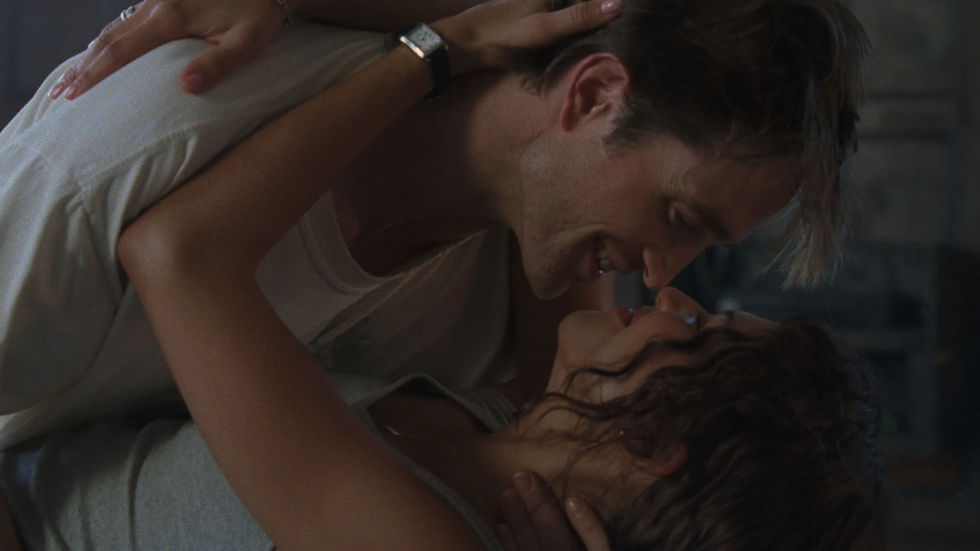
Because what do you do with information like that? Does confession bring you closer, or does it simply redistribute the weight? Emma’s admission destabilizes their relationship. It forces both of them to reckon with the potentially unforgivable on an unforgiving clock: there's only a week, then days, then hours until the wedding, for which someone—presumably Charlie’s British parents—is spending a small fortune.
That compression gives the film its pulse. Arseni Khachaturan’s lush cinematography makes everything feel heightened, almost surreal, even as the emotional reality sharpens. The wedding itself becomes a kind of pressure cooker—harried, unraveling, punctured by Rachel’s alcohol-fueled cruelty (her speech roasting Emma’s lack of friends is the kind of scene that makes you want to disappear).
Everyone is guilty of something. The question becomes: whose guilt matters more? The person who planned but didn't carry out a mass shooting? Or the person who betrayed their partner in the aftermath of learning about it?
The film leaves it up to you to decide.

Can we start over?
If there’s a weakness, it’s that Emma is largely left in emotional purgatory, waiting for Charlie to process a past that's hers but becomes, narratively, his problem. Zendaya is given less room to move than you might expect, her performance constrained by the film’s fixation on Charlie. But even that imbalance reinforces the film’s central tension: this is what it looks like when someone’s past stops belonging solely to them.
The final scene brings the film back to its beginning. A heart bruised Emma and literally bruised Charlie reconvene at their favorite diner. The wedding day has come and gone, leaving behind a mound damage they'll have to wade through. (Couple's therapy?) But still, they reach for something familiar.
Can we start over? she asks.
In this, the film isn’t suggesting that love is impossible in the face of something like this. If anything, it hints that there's a version of love that can survive just about anything. It isn’t asking whether love is real. It’s asking whether it has limits. And judging by both the story it tells and the reaction to it, that answer is far less comfortable than we’d like.


Comments