HULU’S “THE TESTAMENTS” IS WELL WORTH THE RETURN TO GILEAD
Updated: Aug 22
Even the cherished daughters of Gilead’s most powerful men aren’t safe from state violence. Anyone who's watched Hulu’s The Handmaid’s Tale knows this, or at least should. Gilead has never been confused about its priorities. It will take a woman’s name, her child, her body, her eye, her tongue, her finger, her freedom, and still insist the whole arrangement is completely holy. Under his eye.
But the opening stretch of Hulu’s The Testaments makes that old terror feel newly menacing because the girls at the center of this story occupy a different kind of danger. They're children. The protected ones. The precious ones. The ones being trained to become Wives before they’re even old enough to understand that “wife” in Gilead is less a role more a life sentence.

SOME SPOILERS FOR "THE TESTAMENTS" FROM THIS POINT
That’s what makes Season 1 of The Testaments such a bracing sequel. The series doesn’t simply drag us back into the same nightmare with a new set of girls in shiny new bonnets. It moves the horror into dormitories, purity lessons, precarious friendships, and the kind of teenage social politics that would already be stressful without a theocracy breathing down everyone’s neck. Gilead’s brutality is still there, only now it's circular. The regime punishes women who step out of line. But The Testaments teaches young girls to never imagine a line in the first place.
In Gilead they love taking the old testament literally.
Before The Testaments, Hulu’s The Handmaid’s Tale introduced viewers to the Republic of Gilead, a theocratic regime that rises from the ruins of the United States after a fertility crisis and national coup. Women are stripped of their rights and sorted into state-enforced roles: Wives, Marthas, Aunts, and Handmaids. One of those women, June Osborne, is forced into reproductive servitude, and her young daughter, Hannah, is taken from her. For June, Hannah’s abduction becomes the wound that never closes. Even when June survives, even when she resists, even when she makes it out, her daughter remains her tether to the Gilead regime.
Four years have passed since the near end to that original regime and the purges that followed, placing the show on a noticeably different timeline from Margaret Atwood’s novel. Somehow, Aunt Lydia, former teacher turned Gilead power-tripper, has survived her own treachery and clawed her way back into power. She’s now the headmistress of a school important enough to bear her name, complete with an imposing bronze statue where students leave offerings like she’s a minor deity.

The Testaments picks up with Hannah (now played by breakout One Battle After Another star Chase Infiniti) living as Agnes Mackenzie, a Commander’s daughter and dutiful student at Aunt Lydia School. To the regime, Agnes is one of its success stories: a kidnapped child of sin remade into a proper daughter—prim, pious, and dressed like she wandered out of a very repressed storybook. She's also a future Wife being guided toward a marriage that will strengthen the world that claimed her. She’s watched, praised, corrected, and prepared, her life treated as a piece of Gilead property maturing right on schedule.
The school itself quickly becomes the season’s most fascinating pressure point. Agnes begins as a Plum Girl, still technically a child in Gilead’s social order, but already being prepared for transfer into adult obedience. Fully indoctrinated, the Plums are impatient to become women, which in Gilead means being impatient to decorate homes they won’t really own, marry men they didn't actually choose, and graduate from the supervision of the brown-clad Aunts who run Aunt Lydia School, which is about as close to “free” as these girls will ever get.
In the season premiere, “Precious Flowers,” Lydia gives Agnes an unusual assignment: take Daisy, a Canadian runaway, under her wing. Daisy (Lucy Halliday’s sharp-eyed Pearl Girl) arrives under the guise of religious conversion. But the hidden transistor radio and late-night “Radio Free Boston” listening sessions make it clear that her devotion is clearly a ruse. And flashbacks to Toronto suggest that someone very familiar with Gilead’s particular brand of hell may have sent her there to destroy the patriarchy from the inside: June.

Daisy’s mission turns the school into a covert battleground, with Agnes’ coming-of-age and Daisy’s infiltration moving toward the same explosive point. Daisy knows what Gilead really is. Agnes is only beginning to question it. And one wrong step could expose them both.
By the finale, the school has become more than a finishing academy for future Wives. It's the place where Gilead’s next generation is starting to slip out of formation.
Everything's in the Timing. Like Jokes.
The series works best when it leans into the strange, almost debutante-esque nightmare shape of its story. Agnes, Daisy, and their classmates are on the fast track to wedded bliss, or at least Gilead’s bone-dry imitation of it. Some, like the snippy Shunammite (Girl Meets World's Rowan Blanchard at her most watchable) are downright desperate for this chapter of their lives to start and will resort to wild methods to get there.
Others, like Agnes’ best friend Becka (played by Mattea Conforti) would rather eat glass than enter this new phase of womanhood.
The result is a surprisingly effective blend of teen angst and state-sanctioned terror. Raging hormones, jealousy, unrequited crushes, and social climbing feel more pressing to these girls than the question of their autonomy, or even the rebellion slowly transforming their routine field trips into a minefield.

Teen drama is teen drama wherever you set it.
Add Gilead, and suddenly the stakes go from embarrassing hallway encounter to forced marriage with a side of religious fascism. That shift in focus is what makes The Testaments so watchable, even bingeable. The show stokes a fire within its leads with a gentler hand than its predecessor. And when the hellish truths of Gilead do surface, they land through smaller, more intimate devastations. There are even shades of a miniature #MeToo movement in the conspiracy that radicalizes the Plums. And it’s effective, largely because the show still needs to feel like a Handmaid’s Tale story.
Still, I found myself more invested in the mundane drama unfolding during the Plums’ "prom", especially the crossed wires that leave one heroine betrothed to her friend’s forbidden crush, than in the larger resistance machinery humming beneath the season.
The finale, “Secateurs,” brings those pressures to a boil. Becka’s fate after carrying out "God's work", Agnes’ moral awakening, Daisy’s decision to stay in Gilead, and the show’s broader resistance arc push the series from coming-of-age dread into something more combustible.
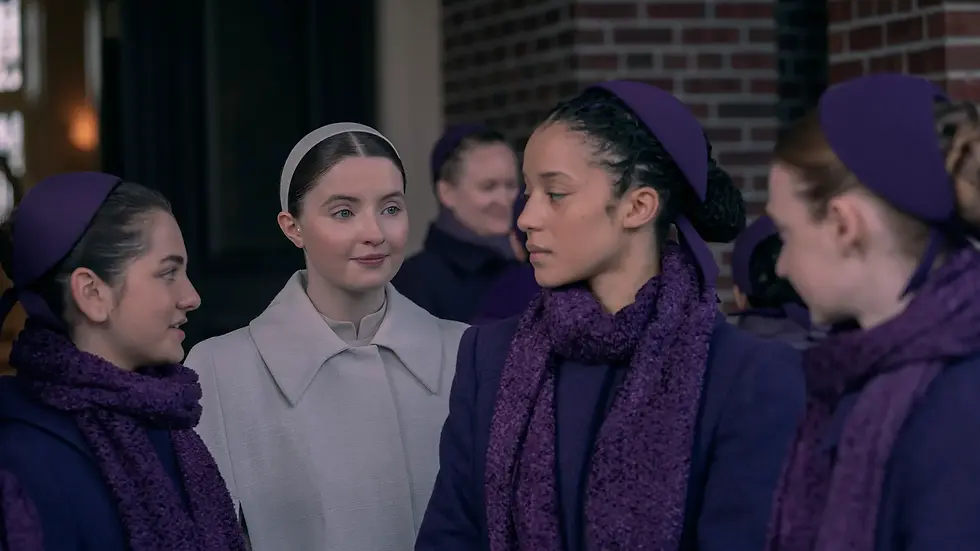
Praise Be.
Chase Infiniti is fantastic as Agnes, a girl raised to swallow discomfort like a sugar pill, yet still capable of becoming the kind of person who could lead a mini revolution of her own. Her best moments come when her girlhood slips, like when she wonders if it’s too late to develop a personality. In a world designed to flatten her into a decorative wife, that tiny admission in this world is radical.
The same goes for the actresses working alongside her, especially Mattea Conforti, whose Becka bears the brunt of Gilead’s twisty, bloody machinations and emerges as the season’s dark horse. Becka could have easily been written as a tragic device, another girl sacrificed to move Agnes closer to her true purpose. Instead, Conforti gives her a trembling interiority that makes her fear, loyalty, and eventual mental breakdown feel painfully earned.
Across the season, Agnes’ instinct to disobey—to pursue love, friendship, curiosity, and freedom of thought—is constantly overwhelmed by her desire to fit the role Gilead has built for her. She's spent her whole life trying to be good in a world where goodness means obedience. Now that she finally knows her true lineage, she also seems to understand that fitting in was never really in the cards. Agnes can never be Gilead’s idea of a perfect wife and mother. And that frees her to become who she’s been all along: June Osborne’s daughter.
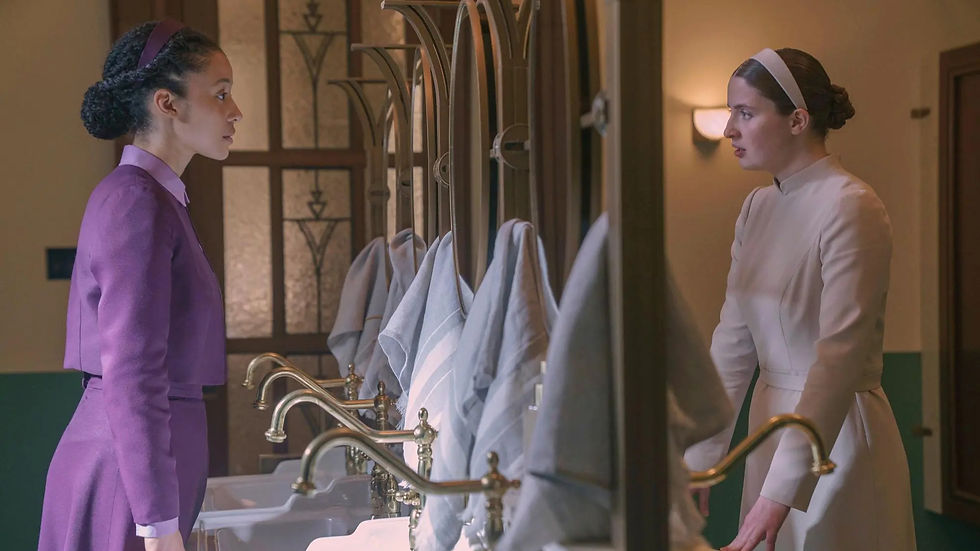
A rebellion is clearly brewing; It's a school full of girls learning, one by one, that obedience and faith are not the same thing. And there's something very 2017-y in this proto-girlboss, “hell is a teenage girl” narrative. The show itself declares in its finale, “Nothing is more powerful than a teenage girl.” It’s a little on the nose, but honestly, so is Gilead. Subtlety left the building around the time the government started color-coding women by reproductive function.
My only hope is that The Testaments doesn’t go the way of Star Wars, where being related to a familiar face is enough to make someone the de facto leader of a rebellion. Agnes is compelling because she's more than June Osborne’s daughter. And the show's future seasons' success will be stronger if it remembers that bloodline can open a door, but it can’t do the character work for her.

8/10 ★ Proves there's plenty of story left in Gilead.
More Book to Screen Adaptations:


Comments