BOOTS RILEY’S “I LOVE BOOSTERS” IS A HILARIOUS, HELLA STYLISH MIDDLE FINGER TO CAPITALISM
Updated: Aug 9
Satire is tricky because when it’s bad, it's real bad. Like you can almost feel the filmmaker standing behind you with a flashlight, pointing directly at the message bad. Capitalism is bad. Rich people are ridiculous. Corporations are evil. Thank you, beloved, we gathered. The harder trick is turning the world slightly sideways so the thing we all live inside suddenly looks as deranged as it actually is.
That is where Boots Riley thrives. His debut feature, Sorry to Bother You, turned corporate America into a literal nightmare. I’m a Virgo stretched policing, labor, and superhero mythology into something too odd to neatly categorize. With I Love Boosters, Riley pushes that imagination further, building a fashion-heist comedy out of stolen luxury goods, retail surveillance, stop-motion flourishes, sci-fi absurdity, and the simple truth that capitalism is, of course, a scam.
The result is a movie that feels like it has twelve tabs open, three alarms going off, and somehow a complete outfit planned. It's gleefully absurd, politically furious, and packed with more ideas than it can always gracefully carry. But even when the back half starts moving like someone spilled Red Bull on the screenplay, I Love Boosters remains proof that Riley is one of the few filmmakers making satire that still feels dangerous, humorous, and genuinely imaginative. Flaws and all, his brand of mayhem has flavor.

SPOILERS FOR "I LOVE BOOSTERS" FROM THIS POINT
They're low-class urban b*tches.
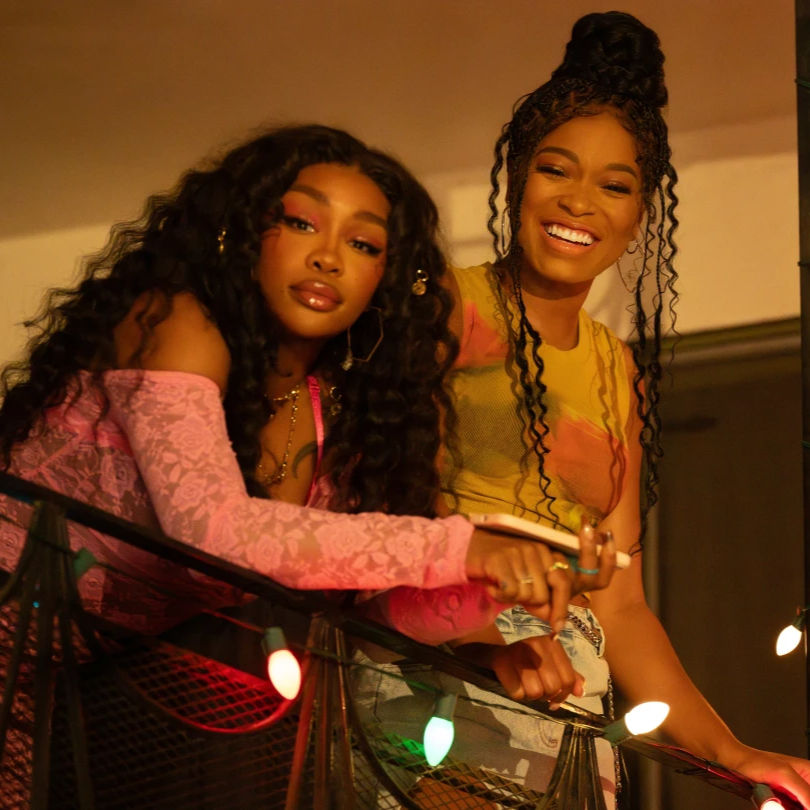
I Love Boosters throws us into the world of Corvette, an aspiring designer turned five-finger-discount specialist played by Keke Palmer with the energy of someone who could easily talk herself out of a felony and into a brand deal. Corvette runs with the Velvet Gang, a crew of boosters who steal designer clothes and resell them to the community at prices that don’t require selling a kidney. Mariah (played by Taylour Paige) calls it “fashion-forward filanthropy”—yes, she knows how philanthropy is spelled. Branding, though.
The Velvet Gang likes to think of themselves as activists with garment bags. Are they redistributing wealth, or are they just really good at stealing? Riley’s answer is basically: look at who gets to steal in public with investors, supply chains, and campaign shoots before clutching pearls over a boosted jacket.
But this isn’t just about petty theft—it’s personal.

Their ultimate target is Christie Smith, a ruthlessly corrupt fashion mogul (played with icy relish by Demi Moore). Christie knows her clothes move on the black market, and she almost seems flattered by it. In her mind, theft becomes proof of desirability. The problem is that Christie has built her empire on theft of her own: underpaid workers, dangerous materials, and stolen designs, including a brilliant “flappy pocket” suit originally created by Corvette. Meanwhile, in a mainland China factory producing Smith’s garments, workers are falling ill with lung cancer thanks to a cheap, sawdust-like fabric she insists on using. At that point, boosting feels less like crime and more like justice.
When the film opens, the Velvet Gang are media darlings planning a big-time inside job. They secure low-paying gigs at one of Smith’s Metro Designer superstores, where their wages are garnished to pay for off-the-rack uniforms.
This scheme gets upended—and then abetted—by Jianhu (played by Poppy Liu), an interloper with a sci-fi-style MacGuffin called a “magic bag,” a machine that can transport and even transform objects. Depending on the setting, it can temporarily turn its target into a heightened version of itself or reduce its subject to its barest essence. (Don't think about it too hard.)

By the time the magic bag enters the picture, I Love Boosters has settled into its own gloriously offbeat rhythm. What begins as a fashion-heist comedy expands into something more ambitious: a story about stolen designs, exploited labor, retail indignities, sci-fi intervention, and the everyday absurdity of trying to survive inside systems designed to keep taking from you.
I know how to spell 'philanthropy'.
Keke Palmer is, unsurprisingly, the movie’s live wire. Homegirl remains one of pop culture’s most incandescent figures for a reason. She's the rare performer whose natural cadence and full-body sense of self can turn almost any line into something bawdy, funny, and completely her own. As Corvette, she gives the film its pulse. The character could've easily become a walking thesis statement in a statement coat, but Palmer gives her swagger, insecurity, and just enough delusion to keep her human. She is half ringleader, half revolutionary hype woman, and fully the kind of role Palmer can hold in the palm of her hand. And watching Corvette talk herself into bigger and bigger trouble is one of the film’s purest pleasures.
The rest of the ensemble meets her at the right level of unhinged.

Taylour Paige gives Mariah a wonderfully kooky energy, while Naomi Ackie brings Sade a drier, more grounded presence that keeps the crew from becoming one long punchline. Poppy Liu adds a sharper edge as Jianhu, especially once the film starts connecting its local hustle to something bigger. And Eiza González is sneakily one of the funniest pieces of the puzzle as Violeta, an eternally vaping retail worker who delivers impossible exposition with the ease of complaining about a shift change.
LaKeith Stanfield, meanwhile, floats in from a stranger movie entirely, which somehow makes perfect sense here. He's proof the cast is a huge reason I Love Boosters can swing this big without flying completely off the rack.
We’ve got five million ways to kill a CEO.
Look, the messaging of I Love Boosters isn’t hard to grasp, but the blunt and energetic accessibility is part of the charm. The movie is strongest when it trusts its own ridiculousness. Riley’s satire works because he understands that capitalism doesn't need to be exaggerated that much to look insane. A company making workers pay for their own uniforms? Barely satire. A fashion mogul stealing from an unknown designer and calling it vision? Happens every day. A think tank full of people who have literally sold their skin to become more useful mouthpieces for the powerful? Okay, that one is a lot. But emotionally? Spiritually? We’ve seen the press tour.

That final reveal, involving Christie’s $100,000 suits and the Skins wearing them, is where I Love Boosters swerves from fashion-world farce into full-on political nightmare. It's gross, blunt, and hard to shake. These aren’t just pundits, consultants, or “concerned citizens.” They are people who've given up their bodies, identities, and basic humanity to sell someone else’s agenda with a sympathetic face. If that sounds ridiculous, turn on literally any cable news panel.
Where the film stumbles is in how much it tries to carry at once. The back half is packed with enough plot, gadgets, reveals, labor politics, romantic weirdness, and visual flourishes to fill three very stylish tote bags. Some emotional threads get shortchanged, especially within the Velvet Gang itself, and you want the film to sit with the women a little longer before the next big idea bursts through the wall.
But even when I Love Boosters feels overstuffed, it's rarely boring. Riley is one of the few filmmakers making political satire that still feels like it has teeth. The movie’s main flaws come from its own ambition, which isn't the worst problem to have in a film landscape where so much feels algorithmically sanded down.

Grab them wigs.
By the end, the most satisfying part of I Love Boosters is that Riley refuses to let the story stop at individual revenge. Corvette wants recognition, sure, and Christie absolutely deserves to be humbled in public. But the movie’s bigger win comes through collective pressure, workers connecting their struggles across stores, factories, and borders.
The heist may be the hook, but the labor revolt is the point. And Riley gives us the fantasy of watching luxury get pushed toward something more radical: the people who make the fantasy finally realizing that they have power too.

8.5/10 ★ A wild fashion-heist about stolen clothes, stolen labor, and theft as business.

Comments