A LOVE LETTER TO THE WHIMSICAL BLACK GIRL
Updated: Aug 9
You know her when you see her, though she rarely arrives in one standard-issue outfit. She might be at the farmers market in a skirt cut from somebody’s very chic curtains, carrying a strawberry-shaped purse, her braids threaded with butterflies, ribbons, and cowrie shells, because restraint is for the Beige Moms. She might be photographing moss, holding a mug that’s a nightmare to wash, her fro inlaid with fresh sunflowers, and dressed as though a woodland creature personally invited her to brunch.
She’s the Whimsical Black Girl, the latest internet name for a kind of Black woman making the world a little stranger and a lot more interesting.
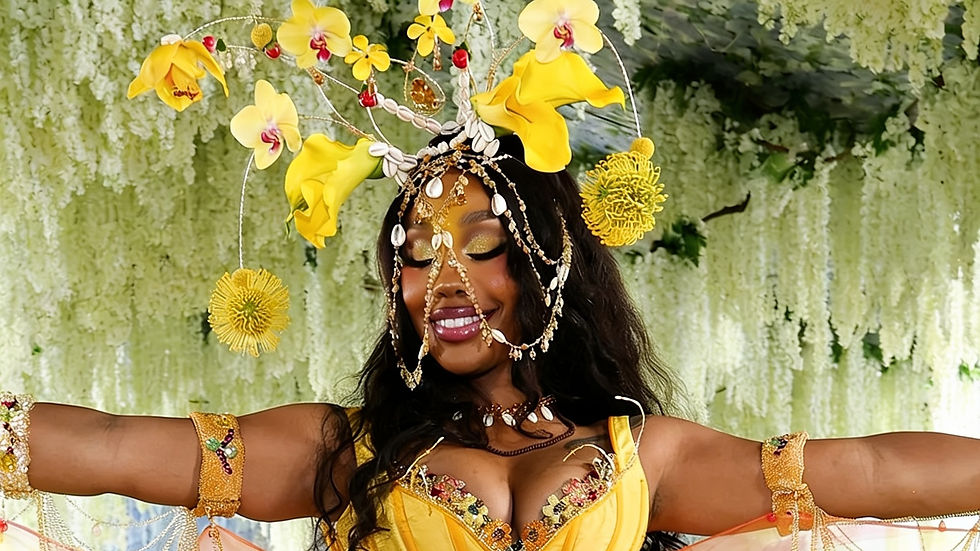
Did you know one of your eyebrows is bright yellow?
“Whimsical” here doesn’t mean childish, vacant, or permanently twirling through a meadow with no awareness of the rent. It means imaginative. Playful. Slightly peculiar on purpose. She treats delight like a serious creative practice and self-presentation as a small act of world-building.
More than a look, the Whimsical Black Girl is a permission slip. Black women are allowed to be odd without turning that oddness into a talent, a brand, or an inspirational TED Talk.
Popular culture has traditionally preferred its Black women legible and useful. Strong enough to carry everyone. Wise enough to fix everything. Beautiful enough to be admired. Entertaining enough to keep everyone comfortable. Even newer archetypes that were supposed to free us came with homework.
Black Girl Magic, which began as a celebration of Black women’s brilliance, could also make brilliance feel like the minimum requirement: be accomplished, unbreakable, immaculately styled, and somehow still available to inspire everybody else.

The Soft Life offered a necessary rejection of all that striving, encouraging Black women to stop treating exhaustion as a personality and rest without apology. Online, though, rest quickly acquired its own shopping list: silk pajama sets, white linen sofa, luxe bubble bath, and suspiciously little visible employment. The fantasy looked peaceful, but it was often built on money, free time, domestic help, and the ability to opt out of pressures most Black women couldn’t simply manifest away. It goes without saying that to have the option of avoiding hardship requires a level of privilege most of us can’t access.
The Whimsical Black Girl offers a different kind of freedom. She’s not trying to prove how hard she can work or how beautifully she can rest. She’s just outside wearing elf ears on a Tuesday.
Academic and writer Saidiya Hartman has a word for this kind of refusal: waywardness. In Wayward Lives, Beautiful Experiments, she calls it “an ongoing exploration of what might be,” a way of imagining life beyond the rules laid out for you. Black whimsy lives somewhere inside that exploration. It’s the freedom to invent a self beyond the ones Black women have been instructed to endure and then go live as her without waiting for permission.
Now, I’m not suggesting every mushroom lamp is an uprising. Sometimes a lamp is just a lamp. But the instinct behind choosing it—the willingness to build a life around curiosity and maximum senseless joy—feels wonderfully wayward.

You’re just as sane as I am.
The Whimsical Black Girl isn’t to be confused with the Nerdy Black Girl, the Awkward Black Girl, or even the Carefree Black Girl, a phrase writer Zeba Blay popularized online to make room for Black women’s joy and the full range of Black womanhood, shaking loose the assumption that Black womanhood had to look burdened at all times. The Whimsical Black Girl wanders a little farther into the woods. She isn’t only carefree; she’s theatrical, handmade, maximalist, and dreamy. And sometimes just a little too committed to the bit.
TV has given us scattered ancestors. On A Different World, the late-’80s sitcom following a group of students at the fictional HBCU Hillman College (currently being rebooted), Freddie Brooks arrived on campus like a gust of incense-scented wind. Played by Cree Summer, Freddie was a wide-eyed freshman with a deep investment in environmental causes, social justice, spirituality, and saying exactly what was on her mind. Her clothes were loose, colorful, and unmistakably bohemian. And she carried herself with the confidence of someone who believed the student union might become an impromptu drum circle at any moment.
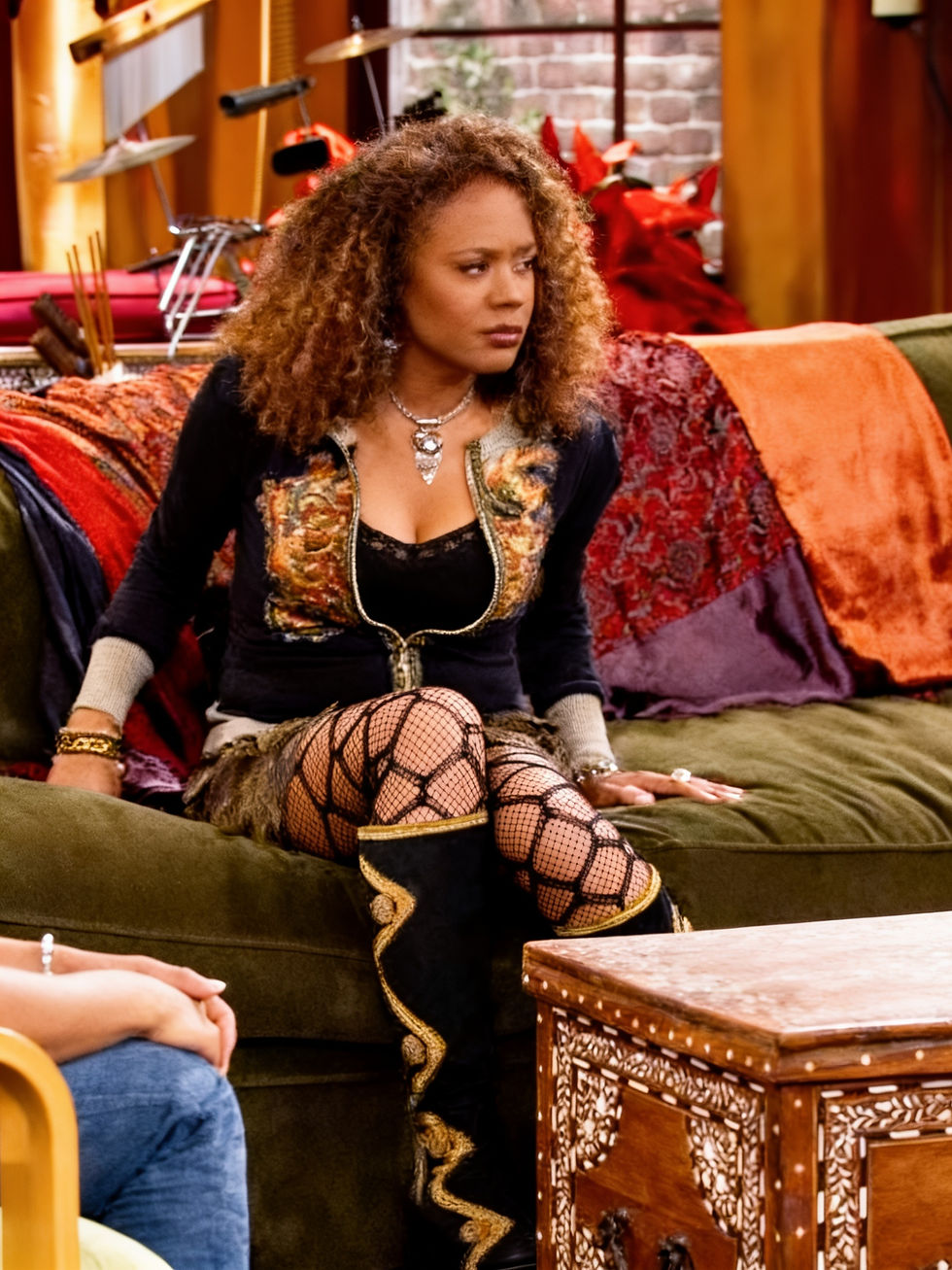
Mona Rose Thorne, the music executive played by Rachel True on the early-2000s sitcom Half & Half, moved through adulthood with a similar boho wardrobe, an open curiosity about the world, and just enough eccentricity to make her seem slightly out of step with the polished people around her. She was free-spirited, independent, and often a little messy, both in her apartment and in life.
More recent tv characters occasionally brush against whimsy without fully living there. On Insecure, Issa Dee’s private mirror raps turned an ordinary bathroom into a tiny stage where she could briefly try on bolder, stranger versions of herself. Abbott Elementary’s Janine Teagues brings patterned cardigans, handmade systems, and an almost supernatural faith in laminated materials to an underfunded Philly public school.
Still, with all the witches, fairies, mermaids, enchanted boarding schools, alternate universes, and suspicious forests television's handed us, popular media has yet to give us a true Black Luna Lovegood. Not without its opportunities. (Looking at you Fate: The Winx Saga. How the heck did you manage to make fairies self serious??)
So, Black women did what Black women tend to do when mainstream culture fails to provide something: built it themselves.
I think they think I’m a bit odd, you know.
Artist Spencer Stultz built Whimsical Black Girl as a shop and creative space centering forms of Black womanhood that don’t fit neatly inside the “strong Black woman” narrative. Her art makes room for Black women who are silly, strange, ambitious, radical, soft, campy, or impossible to summarize in a caption.
Jade Stevenson, known online as Jaded Island, combines Hello Kitty, manga, giant buttons, piles of accessories, and Japanese kawaii substyles into looks that are soft, frilly, and gloriously unconcerned with minimalism. She's also faced the familiar accusation that dressing this way means she’s trying to be white or Asian, because apparently some people believe Blackness comes with a federally mandated capsule wardrobe.
Her clothes provide their own answer: cuteness doesn’t erase Blackness; it expands what Black expression can look like.

Black Fae Day takes the same premise and gives it wings. Started by Jasmine Tucker after she expressed a desire to see more Black people dressed as fairies and other ethereal beings, the annual social media celebration invites Black fantasy fans to transform themselves into elves, mermaids, forest royals, woodland creatures, and any other beings mainstream fantasy has traditionally imagined as pale by default. Timelines fill with brown-skinned fae folk, glittering wings, pointed ears, elaborate staffs, mushroom hats, and enough tulle to alter the weather.
And that’s only one corner of the kingdom. Chazlyn Yvonne builds ethereal, hyper-feminine worlds out of princess dresses, ribbons, pastels, and the conviction that being overdressed is mostly a failure of imagination. Alanna Doherty (@alannanicolex) moves between mixed prints, saturated color, retro references, and tasteful maximalism. Sage Angelica (@kittenholic) pulls from anime and Japanese street style, while Courtney Quinn (@colormecourtney) mixes rainbow palettes, tulle, limitless accessorizing, and a lifelong love of Disney royalty to create what she's dubbed "dopamine dressing".
These women don’t all dress alike, which is kind of the point. Whimsy isn’t a uniform. It’s the willingness to follow a fascination past usefulness, profitability, and occasionally good sense. What connects them isn’t a palette but the pleasure of following an impulse with no obvious practical value.
And naturally, the internet is already trying to turn all of this into a shopping list. Pixie dress. Check. Taxidermied grey mouse. Check. Ruffled socks and suspiciously expensive ceramic butter dish. Check and check. Because the internet can't seem to encounter a way of living without asking whether it comes with an affiliate link.

But you can’t Prime-deliver a point of view.
That’s what I love about the Whimsical Black Girl. She has no interest in making every pleasure earn its keep. Black women are praised so relentlessly for endurance that useless joy can almost look irresponsible. A tiny purse can’t carry the family. A fairy wing can’t protect the community. A three-tiered birthday cake for a pet frog won’t dismantle capitalism.
Fine.
Not every expression of Black life needs to report for duty.
The Whimsical Black Girl isn’t naïve about the world. She knows exactly where she lives. She simply declines to let reality have final creative approval.
And I love her for that.
She isn’t escaping the world. She’s just adding trapdoors and secret gardens.


Comments